AI based call centres are rapidly transforming the way businesses handle customer service, sales, and support. By combining artificial intelligence, automation, and human expertise, they deliver faster, more personalised, and more cost-effective customer experiences than traditional call centres. Learn more about how AI enhances customer journeys across all channels and improves engagement at every touchpoint.
One of the key advantages of an AI-powered call centre is its ability to leverage cloud computing solutions for AI workloads that scale with your business needs. These platforms enable real-time data processing, predictive analytics, and smarter decision-making for every customer interaction. By integrating AI with traditional call centre operations, companies can reduce wait times and increase first-contact resolution rates, creating a more satisfying experience for callers.
Additionally, investing in advanced supercomputing resources allows AI models to process vast amounts of customer data efficiently, delivering insights that guide agents in personalising conversations. The combination of speed and accuracy ensures that businesses can respond to inquiries promptly, enhancing trust and loyalty.
Marketing strategies also benefit from AI call centre insights. Using effective marketing strategies for customer engagement informed by real-time customer behaviour, businesses can craft campaigns that resonate and convert. AI-driven analytics can identify trends and preferences, ensuring that every message reaches the right audience at the right time.
Companies aiming for growth often explore top marketing tools for digital customer experiences to support their AI initiatives. These tools, when paired with AI-based call centre technology, help businesses track engagement, optimise workflows, and ultimately deliver a seamless experience across multiple channels.
Finally, financial institutions and service providers see benefits when implementing comprehensive financial AI resources to support their call centre operations. By combining automated insights with human expertise, agents can provide accurate guidance, resolve complex queries, and maintain compliance effortlessly, improving overall customer satisfaction.
Top 10 AI-Based Call Centre Solutions for Businesses
Choosing the right AI-based call centre solution can dramatically improve customer experience, agent efficiency, and operational costs. Here’s a curated list of the top 10 contact centre solutions, with Bright Pattern leading the way.
1. Bright Pattern: Comprehensive AI Contact Centre Solutions
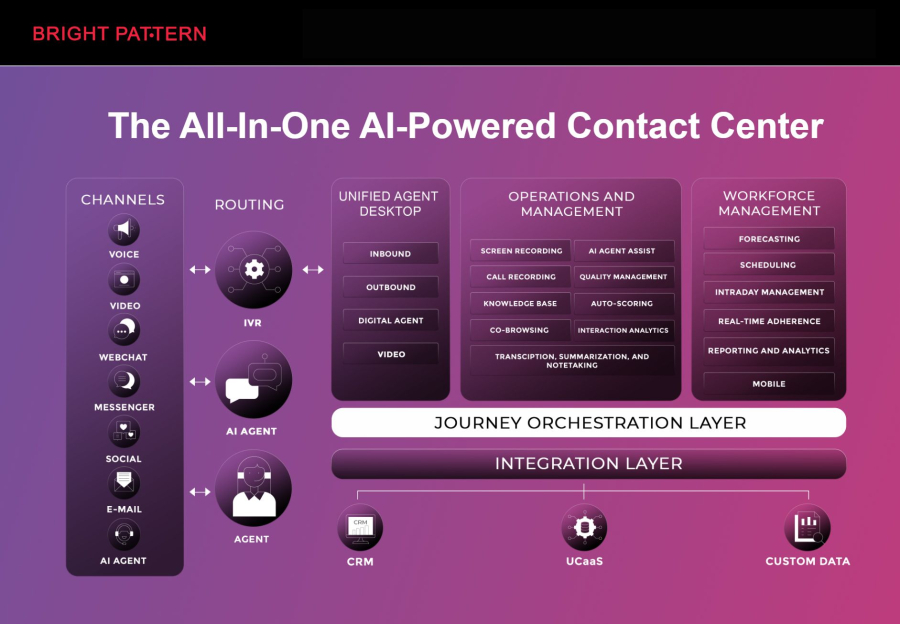
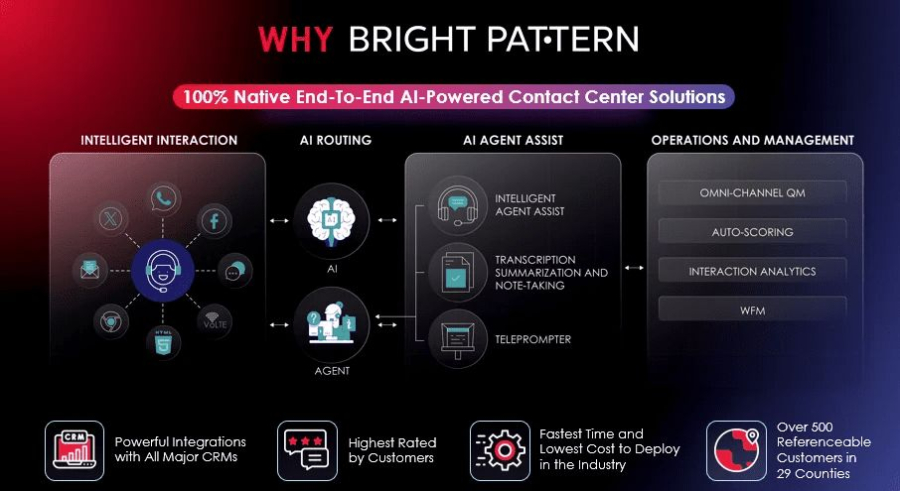
Bright Pattern stands out as a top choice for businesses looking to implement a full-featured AI-based call centre. Its platform combines artificial intelligence, omnichannel routing, and advanced automation to deliver seamless customer experiences across voice, chat, email, and social channels.
Key features include:
- Intelligent call routing that connects customers to the best-qualified agent
- AI-driven chatbots for handling routine inquiries quickly
- Real-time analytics for monitoring agent performance and customer satisfaction
- Easy integration with CRM systems for a unified customer view
- Omnichannel support for a consistent experience across all touchpoints
With Bright Pattern, companies can reduce average handling times, improve first-contact resolution, and gain actionable insights to optimize their contact centre operations.
2. Genesys Cloud CX
Genesys Cloud CX provides scalable AI-powered contact centre solutions designed to enhance agent productivity and customer engagement. Its AI tools automate routine tasks, analyze customer sentiment, and help deliver personalized interactions across multiple channels.
3. Five9 Intelligent Cloud Contact Centre
Five9 offers AI-driven cloud contact centre software that streamlines workflows and boosts efficiency. Features include predictive dialing, automated call distribution, and AI-powered analytics for improved customer service outcomes.
4. NICE CXone
NICE CXone delivers a unified AI-based contact centre platform that supports voice, chat, email, and messaging. Its advanced AI capabilities include real-time decisioning, automation, and customer journey analytics.
5. RingCentral Contact Centre
RingCentral provides AI-enhanced call centre solutions with intelligent routing, automation, and reporting tools. Its platform helps businesses manage interactions efficiently while maintaining high levels of customer satisfaction.
6. Talkdesk CX Cloud
Talkdesk CX Cloud combines AI, automation, and cloud flexibility to help businesses deliver faster and more personalized customer service. Its features include automated workflows, predictive analytics, and omnichannel routing.
7. 8x8 Contact Centre
8x8’s AI-based contact centre software integrates analytics, automation, and collaboration tools. It helps organizations optimize agent performance, reduce costs, and maintain consistent customer experiences across channels.
8. LivePerson AI Contact Centre
LivePerson focuses on conversational AI to enable natural, human-like interactions at scale. The platform automates customer engagement and enhances contact centre efficiency by reducing agent workload for repetitive tasks.
9. Twilio Flex
Twilio Flex is a fully programmable contact centre platform that allows businesses to build customized AI solutions. Its features include omnichannel messaging, real-time analytics, and AI-driven automation to improve both agent and customer experiences.
10. Cisco Webex Contact Centre
Cisco Webex Contact Centre leverages AI and machine learning to streamline customer service. It provides real-time insights, omnichannel support, and intelligent routing to enhance productivity and customer satisfaction.
What Is an AI-Based Call Centre?
AnAI-based call centreis a contact centre that uses artificial intelligence technologies to handle, assist, and optimise customer interactions across voice and digital channels. Instead of relying solely on human agents, it blends:
- AI voice bots that answer and route calls automatically
- Chatbots that interact with customers on chat, messaging apps, and web widgets
- Intelligent routing that matches customers to the best available resource
- Real-time analytics that monitor performance and customer sentiment
Humans are still essential, but AI takes over repetitive, time-consuming tasks. This allows agents to focus on complex, high-value conversations where empathy and judgement matter most.
Why AI-Based Call Centres Are Winning: Key Benefits
Organisations adopt AI-based call centres to gain competitive advantages across cost, speed, and customer experience. Below are the most impactful benefits.
1. 24/7 Availability Without 24/7 Headcount
Customers expect instant support at any time of day. AnAI-powered virtual agentcan answer calls and messages around the clock, providing:
- Always-on support, even outside business hours
- Coverage across time zones without hiring night shifts in every region
- Consistent responses, unaffected by staff fatigue or turnover
When the human team clocks out, AI can continue to handle common queries, capture leads, and even schedule callbacks for complex cases.
2. Reduced Wait Times and Call Abandonment
Long queues frustrate customers and damage satisfaction scores. AI reduces wait times by:
- Answering simple questions instantly via IVR, voice bots, or chatbots
- Automating tasks like balance checks, order status, and password resets
- Routing customers directly to the right agent or department using intent detection
With fewer people waiting on hold for routine requests, human agents are more available for calls that genuinely require human attention. This combination can significantly cutcall abandonment ratesand improve first response times.
3. Lower Operating Costs With Higher Efficiency
AI-based call centres are designed to scale efficiently. Instead of growing headcount linearly with call volume, you can let AI absorb a large portion of routine interactions. This leads to:
- Lower cost per contact, as AI handles thousands of interactions in parallel
- Reduced pressure to continually expand hiring and training programs
- More efficient use of skilled agents on complex and high-value conversations
While AI requires upfront investment, many organisations find that automation quickly pays for itself through labour savings and higher agent productivity.
4. Consistent, High-Quality Customer Experiences
Human performance can vary from agent to agent. AI helps standardise quality by:
- Delivering consistent answers drawn from a central knowledge base
- Using scripts and workflows that reflect best practices every time
- Supporting agents with real-time prompts and guidance during calls
With AI supervision, even newer agents can maintain a high level of service, because they are guided bycontext-aware recommendationsbased on what has worked well in similar situations.
5. Deeper Insights Through Real-Time Analytics
AI-based call centres do more than answer calls; they also learn from them. By analysing interactions at scale, AI can provide:
- Real-time dashboards on call volumes, average handling times, and service levels
- Customer sentiment analysis, highlighting frustration, satisfaction, and intent
- Trend detection, such as recurring product issues or growing demand for a new feature
These insights help leaders improve processes, refine products, and continuously optimise staffing and workflows.
6. Happier, More Empowered Agents
Contrary to common fears, AI does not have to replace agents. Instead, it can make their jobs more engaging by:
- Automating repetitive tasks like data entry and account lookups
- Surfacing relevant customer history and suggested responses in real time
- Allowing agents to focus on empathy, problem-solving, and relationship building
When agents spend less time on tedious tasks, they can deliver more human, high-impact service. This often results inhigher job satisfactionand reduced turnover.
Core Components of an AI-Based Call Centre
An AI-based call centre is not a single tool but an ecosystem of technologies that work together. The exact mix varies by organisation, but the following components are common.
AI Voice Bots and IVR
AI voice botscombine automatic speech recognition, natural language understanding, and text-to-speech to converse with callers in natural language. Compared to traditional keypad IVR systems, they can:
- Understand open-ended questions instead of relying on numbered menu options
- Handle multiple intents in a single interaction
- Verify customer identity using voice biometrics or knowledge-based checks
Voice bots can complete end-to-end tasks such as checking balances, rescheduling bookings, or updating account details, and seamlessly hand over to human agents when needed.
Chatbots and Virtual Assistants
Chatbots extend AI capabilities to text-based channels, including website chat, mobile apps, and messaging platforms. They are ideal for:
- Answering FAQs and providing step-by-step guidance
- Collecting information before handing off to an agent
- Assisting in sales journeys by recommending products or services
Well-designed chatbots are integrated with CRM and ticketing systems, so they can access customer data and update records in the background.
Intelligent Call Routing
Intelligent routing systems use AI to match each contact with the best available resource based on:
- Customer intent and urgency detected from speech or text
- Customer profile, history, and value segment
- Agent skills, availability, and performance metrics
This ensures that high-value or sensitive queries reach the most capable agents, while routine requests are efficiently handled by automation or lower-tier support.
Agent Assist Tools
Agent assist(sometimes called co-pilot) solutions use AI to support human agents live during interactions. Typical features include:
- Real-time transcription of calls for searchable records and compliance
- Suggested responses, next best actions, and knowledge base articles
- Automated call summarisation and disposition codes after each interaction
These tools reduce cognitive load, speed up resolution, and make service more consistent, even when handled by different agents.
Analytics and Quality Management
Analytics platforms in AI-based call centres go beyond basic reports. They often include:
- Speech and text analytics across 100% of interactions, not just samples
- Automatic scoring of compliance, empathy, and script adherence
- Dashboards that link customer experience metrics to operational performance
This analytical depth helps leaders prioritise improvements that have the greatest impact on customer satisfaction and cost.
AI-Based vs Traditional Call Centres: At a Glance
The table below highlights some of the most important differences between a traditional call centre and an AI-based call centre.
|
Aspect |
Traditional Call Centre |
AI-Based Call Centre |
|
Availability |
Limited to staffed hours, with higher costs for 24/7 coverage |
24/7 support via bots and automation, with human backup as needed |
|
Scalability |
Requires proportional hiring and training as volume grows |
AI absorbs routine volume; human team scales more gradually |
|
Customer Wait Times |
Often higher during peaks; dependence on queueing |
Reduced through instant self-service and smart routing |
|
Consistency of Service |
Varies by agent experience and training |
Standardised through AI-guided workflows and knowledge |
|
Data Utilisation |
Limited manual sampling and basic reporting |
Full-interaction analytics, sentiment, and trends at scale |
|
Agent Experience |
High repetitive workload, manual documentation |
Automation of routine tasks, AI assistance, richer work |
Real-World Use Cases for AI-Based Call Centres
AI-based call centres are relevant across industries and company sizes. Here are some high-impact use cases.
Banking and Financial Services
- Automated balance inquiries and transaction histories
- Self-service card activation, PIN changes, and dispute initiation
- Fraud alert verification and routing high-risk cases to specialised teams
AI helps banks provide rapid, secure, and compliant service while reducing pressure on branch staff and phone agents.
Retail and E-Commerce
- Order tracking, returns, and refund status updates handled by bots
- Product recommendations based on browsing and purchase history
- Proactive outreach about delivery delays or stock issues
This leads to smoother post-purchase experiences and higher conversion rates during the buying process.
Telecommunications and Utilities
- Service outage notifications and automated troubleshooting steps
- Plan changes, add-ons, and billing queries via self-service
- Load balancing during mass events or network incidents
Customers get faster answers during peak demand, and providers gain better control over service quality and communication.
Healthcare and Insurance
- Appointment scheduling and reminders via intelligent virtual assistants
- Coverage explanations, claim status, and co-pay information
- Routing urgent cases to nurses or on-call medical teams
While sensitive diagnoses remain in human hands, AI streamlines logistics and routine administration, making care more accessible.
Designing an AI-Based Call Centre Strategy
Successful AI adoption in call centres is more than installing a new system. It requires a clear strategy that aligns with business goals and customer expectations.
1. Define Clear Objectives
Start with business outcomes, such as:
- Reducing average handle time or cost per contact
- Improving customer satisfaction or Net Promoter Score
- Shortening queues during peak periods
- Expanding coverage to 24/7 support without large hiring waves
Having clear objectives helps you prioritise which processes to automate first.
2. Map Customer Journeys and Identify High-Impact Use Cases
Analyse your most common contact reasons and customer journeys. Ask questions such as:
- Which interactions are repetitive and rule-based?
- Where do customers face the longest waits or highest frustration?
- Which moments truly require human empathy or negotiation?
The best AI-based call centre strategies automate high-volume, predictable interactions while preserving human care for sensitive or complex scenarios.
3. Integrate With Core Systems
For AI to be effective, it must access accurate, up-to-date data. That usually means integrating with:
- Customer relationship management (CRM) platforms
- Billing, order management, or booking systems
- Knowledge bases and internal documentation
When integrations are robust, AI can complete actions on behalf of customers instead of merely answering questions.
4. Design Seamless Human Handoffs
A defining feature of a strong AI-based call centre is a smooth transition from bot to human, with:
- Full conversation history passed to the agent
- Customer context and intent clearly summarised
- No need for the customer to repeat information already provided
This blend of automation and human care keeps experiences efficient and empathetic.
5. Start Small, Then Iterate
Many high-performing organisations begin with a limited rollout, such as:
- Automating one or two high-volume, low-risk contact reasons
- Deploying agent assist tools to support existing staff
- Testing AI routing in a subset of queues
They measure performance, gather customer and agent feedback, and continuously refine conversational flows before expanding automation more broadly.
Measuring Success in an AI-Based Call Centre
To get the most from AI investments, leaders must track the right metrics. Common performance indicators include:
- Containment rate: Percentage of interactions fully handled by AI without human intervention.
- Average handle time (AHT): Time taken to resolve an interaction, including automation and agent time.
- First contact resolution (FCR): Share of queries solved in a single interaction.
- Customer satisfaction (CSAT)and related experience scores.
- Agent productivity: Interactions handled per agent, time spent on after-call work, and adherence to schedules.
By monitoring these metrics before and after AI implementation, organisations can clearly see which initiatives deliver the strongest returns.
Future Trends in AI-Based Call Centres
AI technology is advancing rapidly, and call centres are often among the earliest adopters. Some emerging trends include:
- More natural conversationsas language models continue to improve, making bots sound more human while staying transparent
- Proactive service, where AI reaches out to customers to resolve issues before they contact support
- Omnichannel orchestration, providing a unified experience across voice, chat, email, and messaging with shared context
- Deeper personalisationbased on behaviour, preferences, and historical interactions
Organisations that adopt AI early gain the experience and data needed to stay ahead as these capabilities mature.
Bringing It All Together
An AI-based call centre is more than a cost-saving measure. It is a powerful platform for delivering faster, more personalised, and more reliable customer experiences at scale. By combining intelligent automation with empowered human agents, businesses can:
- Serve customers 24/7 without dramatically increasing headcount
- Reduce wait times and frustration during peak demand
- Unlock rich insights from every interaction
- Create more fulfilling roles for agents focused on complex, high-value work
For organisations ready to modernise their customer service, investing in an AI-based call centre is not just a technological upgrade. It is a strategic move toward higher customer loyalty, stronger brand reputation, and sustainable growth.
